I snapped this photo of blueberry jelly at the posh supermarket chain Pão de Açucar. It has the same kinds of products and clientele as a Whole Foods would have in the U.S. Blueberries, and berries in general, do not naturally grow in Brazil, and are very expensive when imported. This jar of jelly was around US$10. But the reason I snapped this picture was because I never knew the Portuguese word for blueberry, which is apparently mirtilo. As, this picture demonstrates however, Brazilians also don't know the Portuguese for blueberry. It's much more common for blueberries and blackberries, when they arrive, to be labelled by their English names. Rasberries and strawberries are referred to by their more common Portuguese names.
Anyways, I was pleased to be as ignorant about the Portuguese word for blueberry as the average middle class Brazilian.
Saturday, December 3, 2011
Saturday, November 26, 2011
Dancers' Dillema
As I am sure I have complained about before, São Paulo nightlife culture has invented incredibly complex and expensive ways to control who gets in and who stays out of parties. Most social scientists that I read on Sao Paulo and in general lefitst or even cynical paulistanos would agree that this is a particularly absurd manifestation larger social strategies of class segregation. To give an example of how this works. For almost any party (i.e. any event that has a dj and a dancefloor) at a bar or club, you have to get your name on the list. Sometimes the list is just for a discount off the door price. Keep in mind door prices start at around US$15 and can go up to US$80. And drinks are separate. (In fact, São Paulo law says that you can charge admission or minimum consumption at an event, but you can't charge both). Many lists are by invitation only, or reach capacity days before the event. There are regular lists and VIP lists. Usually, VIPs or convidados (invited guests) pay less or nothing. To have to pay would mean that you are not cool enough to be wanted by the club.
All this makes me normally stay at home. Yesterday, however, I put my name on the list for a party that I have heard good things about: Voodoohop. It is known as a more underground, democratic party, where the cover is usually US$6-10. This month, they have a really creative system for the list and cover. The party is being called a "Prisoners' Dilemma" and the cover charge will work on a modified version of the classic decision-making game. Every person who puts their name on the list has the option to ask for a "Courtesy Invite" for the event. If no one asks the for the courtesy invite, everyone pays R$10 (US$5.35 this week). If under 15 percent ask for the courtesy invite, they will go in free, and the other majority will pay R$15. If over 15 percent of the people ask for the courtesy invite, everyone will pay R$25. I thought this was a very creative way of burlesquing the whole list system. Usually so entrenched in modes of distinction, this requires people think about working together.
We'll see how well that works. If I end up actually going, I will let people know.
All this makes me normally stay at home. Yesterday, however, I put my name on the list for a party that I have heard good things about: Voodoohop. It is known as a more underground, democratic party, where the cover is usually US$6-10. This month, they have a really creative system for the list and cover. The party is being called a "Prisoners' Dilemma" and the cover charge will work on a modified version of the classic decision-making game. Every person who puts their name on the list has the option to ask for a "Courtesy Invite" for the event. If no one asks the for the courtesy invite, everyone pays R$10 (US$5.35 this week). If under 15 percent ask for the courtesy invite, they will go in free, and the other majority will pay R$15. If over 15 percent of the people ask for the courtesy invite, everyone will pay R$25. I thought this was a very creative way of burlesquing the whole list system. Usually so entrenched in modes of distinction, this requires people think about working together.
We'll see how well that works. If I end up actually going, I will let people know.
Wednesday, November 16, 2011
Soap and Water
Two of my friends on facebook posted this video (below) of Brazilian soap opera stars calling on Brazilians to sign a petition against the hydroelectric damn Belo Monte. For those of you who don't know, the Belo Monte damn will be the third largest hydroelectric damn in the world. It will also flood about 600 hectares of the Amazon and displace many Xingu indigenous communities. At the Occupy São Paulo, and in various protests I have attended in São Paulo, stopping the Belo Monte project consistently emerges as one of the key agenda items of the left. The fight against Belo Monte has also been featured internationally in news venues like Democracy Now.
Ok, the video in question cannot be embedded because blogger, as part of the google empire, will only work with youtube. but the video can be accessed at http://vimeo.com/32115701. Sorry no transcript or subtitles. A little bit translated below.
This video is part of a series of comic/creative videos calling on Brazilian citizens to criticize the Belo Monte project. The plea from soap opera stars strikes me as pretty interesting for a variety of reasons.
1. The long history of mass media (particularly the super channel TV Globo) working with the federal government. Scholars of Brazilian media often say that broadcast television, and in particularly soap operas, are a major organ of the transmission of "ideal Brazilian values" and pro-government messages. Although television usually helps center-right governments and not the center-left Worker's Party currently in power.
2. A lot of soap opera stars do make public service announcements, but they usually focus on development, empowerment, or other non-devisive issues (like literacy or immunizations). Again, usually such calls are in support of government welfare programs.
3. The call for Brazilians (particularly in the South and Southeast) to have a more national and global perspective, and the soft satire of the comfortable middle class. The beginning of the video starts with various vingettes of why people (presumably in the industrialized South) should care about that far state of Pará. The soap opera stars mimic potential responses of indifference.
"Eu pago meus impostos, eu reciclo meu lixo, eu ensino meus filhos."
"Eu ainda tenho que me preocupar com hidroelectrico no Pará?"
[I pay my taxes, I recycle my trash, I teach my children. And I still have to concern myself with a damn in Pará?]. The trope, "I am a citizen, I pay my taxes, I raise my kids" is a popular one amongst the middle classes in São Paulo and Rio (and presumably other major cities). It usually has the overtone of I am a pessoa do bem (a person who makes good, usually meaning that they have a job and are not a bum). Here, the actress Juliana Pas invokes that group as the ideal political actor who should hear this message, but also mocks such a position, as not enough to act politically.
"Se não tem hidroelectrica, não vai ter energia, e dai, como vou assistir minha novela?"
"Gente preciso de luz, sou a pessoa mais conectada...Como que vou ficar sem energia, sem ipod, sem iphone, sem itudo."
[If we don't have the damn, there will be no electricity, how am I going to watch my soap opera? People, I need energy, I am, like, the most wired person. How am I going to go without power, without an Ipod, Iphone, Ieverything?] The parody here probably speaks for itself. But it is interesting to note soap opera stars satirizing their own public.
4. The critique of Brazilian progress. This is probably the most interesting. Since the Brazilian economy has had unprecedented sustained growth in the past seven or eight years or so, and since the global financial crisis barely skimmed Brazil, there has been an air of confidence about Brazilian society. This has included a self-congratulatory ethos that industrialization and consumerism show how much Brazil has arrived. This is one of the first things I have seen that comes close to the Brazilian mainstream that is starting to question that connection.
Ok, the video in question cannot be embedded because blogger, as part of the google empire, will only work with youtube. but the video can be accessed at http://vimeo.com/32115701. Sorry no transcript or subtitles. A little bit translated below.
This video is part of a series of comic/creative videos calling on Brazilian citizens to criticize the Belo Monte project. The plea from soap opera stars strikes me as pretty interesting for a variety of reasons.
1. The long history of mass media (particularly the super channel TV Globo) working with the federal government. Scholars of Brazilian media often say that broadcast television, and in particularly soap operas, are a major organ of the transmission of "ideal Brazilian values" and pro-government messages. Although television usually helps center-right governments and not the center-left Worker's Party currently in power.
2. A lot of soap opera stars do make public service announcements, but they usually focus on development, empowerment, or other non-devisive issues (like literacy or immunizations). Again, usually such calls are in support of government welfare programs.
3. The call for Brazilians (particularly in the South and Southeast) to have a more national and global perspective, and the soft satire of the comfortable middle class. The beginning of the video starts with various vingettes of why people (presumably in the industrialized South) should care about that far state of Pará. The soap opera stars mimic potential responses of indifference.
"Eu pago meus impostos, eu reciclo meu lixo, eu ensino meus filhos."
"Eu ainda tenho que me preocupar com hidroelectrico no Pará?"
[I pay my taxes, I recycle my trash, I teach my children. And I still have to concern myself with a damn in Pará?]. The trope, "I am a citizen, I pay my taxes, I raise my kids" is a popular one amongst the middle classes in São Paulo and Rio (and presumably other major cities). It usually has the overtone of I am a pessoa do bem (a person who makes good, usually meaning that they have a job and are not a bum). Here, the actress Juliana Pas invokes that group as the ideal political actor who should hear this message, but also mocks such a position, as not enough to act politically.
"Se não tem hidroelectrica, não vai ter energia, e dai, como vou assistir minha novela?"
"Gente preciso de luz, sou a pessoa mais conectada...Como que vou ficar sem energia, sem ipod, sem iphone, sem itudo."
[If we don't have the damn, there will be no electricity, how am I going to watch my soap opera? People, I need energy, I am, like, the most wired person. How am I going to go without power, without an Ipod, Iphone, Ieverything?] The parody here probably speaks for itself. But it is interesting to note soap opera stars satirizing their own public.
4. The critique of Brazilian progress. This is probably the most interesting. Since the Brazilian economy has had unprecedented sustained growth in the past seven or eight years or so, and since the global financial crisis barely skimmed Brazil, there has been an air of confidence about Brazilian society. This has included a self-congratulatory ethos that industrialization and consumerism show how much Brazil has arrived. This is one of the first things I have seen that comes close to the Brazilian mainstream that is starting to question that connection.
Tuesday, November 15, 2011
Reading Butler in Butantã
This is the introduction/interlude for a longer piece I intend to write on Queer Americana. In the larger paper, I will argue about the way a group of texts commonly labelled together as "Queer Theory" contains and is consumed outside of the U.S. as a kind of Americana. I plan to begin the paper with some observations in LGBT politics and marketing that show the affective pull and the analytic and symbolic reinterpretations of queer theory. Here is a rough draft of that opening part.
I was at first surprised how many younger LGBT activists expressed a need to learn "queer theory," for a few reasons. First, many LGBT activists I talked with previously expressed a resounding belief that queer theory was not "political." Because queer was "against identity" (contra identidade), there was no way to gain human rights (the ostensible objective for many). Second, some younger activists (many of whom were also liberal arts students), expressed a confident derision of postmodernism as a neo-liberal ideology. Nevertheless, many of the reasons people had for learning queer theory were equally compelling. In one meeting, activists decided that they would teach themselves queer theory, because "everyone is talking about it," and they needed to understand what it was all about before they dismissed it (or possibly embraced it). Another activist, "Pedro," a lawyer by training, had at first told me that he was against overly academic texts in general because they were inaccessible to many people and thus elitist. This conversation was specifically in regard to Lacan, which is very popular amongst some leftist Brazilian scholars. A month later, Pedro, upset by the comments a doctor had made at a transgender health conference, said that we needed to make LGBT politics in São Paulo more queer. When I asked him what this meant, he said that we needed to a conceptual-political tool that would be more critical of the medical reasoning that allowed the doctor to say that breast implants in a bio-woman were perfectly normal, but a bio-man should have a psych evaluation before having implants. Fair enough.
I wasn't surprised that queer theory was seen as North American. Queer theory can be interpreted, especially by many of its critics, as just one more colonial imposition on global South cultures. Major scholars in the U.S., such as Joseph Massad and Gayatri Gopinath are well known for making these critiques. But I have been struck by the particularities by which queer theory is seen as American. For more than a few people I have talked to, queer theory represents a very post-identity America, markedly Californian, and retains a certain hippiness to it. That is, if you ask LGBT people who have heard the word queer, many if not most will tell you that it's about the freedom to be what you want, that there are no rules. In fairness, this was an early interpretation of Judith Butler's work that scholars everywhere made. And it is an interpretation against which Butler spent many years trying to protest, combat, rectify, and elaborate. Nevertheless, this interpretation of queer as fluidity merges a little too neatly with older concepts of Brazilian sexuality as free, liberal, without labels. I was always skeptical of the way in which queer was often substitutable for modern. As another activist sarcastically joked, expensive gay clubs aren't gay, they're "modern." People will say, "ah, não gosto do rótulo." (Ahh, I don't like labels).
As queer was defined as not only American, but a certain kind of American: progressive left, critical of mass culture, post-identity, I have become more and more recruited by my interlocutors as a spokesperson for queer theory. This is a role that I have taken with some ambivalence. On the one hand, I appreciated that my interlocutors were interested in debate and wanted something from me that I could (presumably) give them. On the other hand, I have a lot of conflicting views about queer theory. I am not sure it actually exists, and it certainly isn't presentable as a set of coherent analytic mandates that many were looking for. Further, I have worked hard to get to know Brazilian academia, and I didn't want to be the American grad student who comes in and tells people that everything that they are reading and discussing is wrong, or worse, old.
I ended up teaching a course in queer theory at the University of São Paulo (Butantã campus) this past semester, and a lot of my observations are going to comprise the body of this paper. The course had a lot of problems (finding translations, getting people motivated to participate, etc). But there were also some really great results. After reading Butler's "Critically Queer," one student who was active in coordinating the class said that he wasn't sure if Brazil still needed queer theory. One of Butler's main arguments in this text is that "queer" as an appropriation of a sexual ephithet, always indexes a past pain. Queer thus always contains a melancholia (a refusal to discharge the mourned object) that is one of the sources of its radicality. (It's complicated. I'm simplifying and doing disservice to the article right now). For this student, the problem was obvious. How are we (in Brazil) supposed to share in this radical melancholy, when the term itself doesn't index a past pain as it does for Americans? I don't have any solutions for that question right now, and I doubt that I will have any ready for the final paper. But instead, I think it is interesting to ask whether this melancholia does produce a certain kind of Americana, which might be accessible to others, but becomes radically transformed without a shared history?
I was at first surprised how many younger LGBT activists expressed a need to learn "queer theory," for a few reasons. First, many LGBT activists I talked with previously expressed a resounding belief that queer theory was not "political." Because queer was "against identity" (contra identidade), there was no way to gain human rights (the ostensible objective for many). Second, some younger activists (many of whom were also liberal arts students), expressed a confident derision of postmodernism as a neo-liberal ideology. Nevertheless, many of the reasons people had for learning queer theory were equally compelling. In one meeting, activists decided that they would teach themselves queer theory, because "everyone is talking about it," and they needed to understand what it was all about before they dismissed it (or possibly embraced it). Another activist, "Pedro," a lawyer by training, had at first told me that he was against overly academic texts in general because they were inaccessible to many people and thus elitist. This conversation was specifically in regard to Lacan, which is very popular amongst some leftist Brazilian scholars. A month later, Pedro, upset by the comments a doctor had made at a transgender health conference, said that we needed to make LGBT politics in São Paulo more queer. When I asked him what this meant, he said that we needed to a conceptual-political tool that would be more critical of the medical reasoning that allowed the doctor to say that breast implants in a bio-woman were perfectly normal, but a bio-man should have a psych evaluation before having implants. Fair enough.
I wasn't surprised that queer theory was seen as North American. Queer theory can be interpreted, especially by many of its critics, as just one more colonial imposition on global South cultures. Major scholars in the U.S., such as Joseph Massad and Gayatri Gopinath are well known for making these critiques. But I have been struck by the particularities by which queer theory is seen as American. For more than a few people I have talked to, queer theory represents a very post-identity America, markedly Californian, and retains a certain hippiness to it. That is, if you ask LGBT people who have heard the word queer, many if not most will tell you that it's about the freedom to be what you want, that there are no rules. In fairness, this was an early interpretation of Judith Butler's work that scholars everywhere made. And it is an interpretation against which Butler spent many years trying to protest, combat, rectify, and elaborate. Nevertheless, this interpretation of queer as fluidity merges a little too neatly with older concepts of Brazilian sexuality as free, liberal, without labels. I was always skeptical of the way in which queer was often substitutable for modern. As another activist sarcastically joked, expensive gay clubs aren't gay, they're "modern." People will say, "ah, não gosto do rótulo." (Ahh, I don't like labels).
As queer was defined as not only American, but a certain kind of American: progressive left, critical of mass culture, post-identity, I have become more and more recruited by my interlocutors as a spokesperson for queer theory. This is a role that I have taken with some ambivalence. On the one hand, I appreciated that my interlocutors were interested in debate and wanted something from me that I could (presumably) give them. On the other hand, I have a lot of conflicting views about queer theory. I am not sure it actually exists, and it certainly isn't presentable as a set of coherent analytic mandates that many were looking for. Further, I have worked hard to get to know Brazilian academia, and I didn't want to be the American grad student who comes in and tells people that everything that they are reading and discussing is wrong, or worse, old.
I ended up teaching a course in queer theory at the University of São Paulo (Butantã campus) this past semester, and a lot of my observations are going to comprise the body of this paper. The course had a lot of problems (finding translations, getting people motivated to participate, etc). But there were also some really great results. After reading Butler's "Critically Queer," one student who was active in coordinating the class said that he wasn't sure if Brazil still needed queer theory. One of Butler's main arguments in this text is that "queer" as an appropriation of a sexual ephithet, always indexes a past pain. Queer thus always contains a melancholia (a refusal to discharge the mourned object) that is one of the sources of its radicality. (It's complicated. I'm simplifying and doing disservice to the article right now). For this student, the problem was obvious. How are we (in Brazil) supposed to share in this radical melancholy, when the term itself doesn't index a past pain as it does for Americans? I don't have any solutions for that question right now, and I doubt that I will have any ready for the final paper. But instead, I think it is interesting to ask whether this melancholia does produce a certain kind of Americana, which might be accessible to others, but becomes radically transformed without a shared history?
Sunday, November 13, 2011
Officeboy vs. Playboy
Do to the awesome response to playboys on my last post (one comment and one email!), I thought I would add one more post on the playboy and a competing archetype: the officeboy.
This morning I was listening to Bonde do Role's 2007 "With Lasers." BdR is/was an electroclash band that got pulled from obscurity and brought to the U.S. by former M.I.A. producer/boyfriend Diplo. In the North, they were the hipster shit for 20 minutes. I saw them at the Empty Bottle in Chicago in Octoberish 2007 (definitely during systems, as I recall). I've met very few people in Brazil who know about them, especially compared to their more successful contemporary exports, Cansei de Ser Sexy.
Anyways, as I was drinking coffee, typing a little, and listening to BdR, I realized that the first line of their song "officeboy" is "Trabalhando o ano inteiro de officeboy, para o final de ano pagar de playboy." [Working the whole year as an office boy, so (you can) spend like a playboy at year's end.]
Despite the professional sounding ring of "office," one would understand the term better by focusing on the pejoratively used "boy." Office boys are usually the working class 20-somethings who work as errand boys in Brazil's financial districts, particularly in São Paulo. As Teresa Caldeira writes, these "boys" and their mobile counter parts (motoboys) are paid low wages in order to curry documents up and down the street and take the subway to do so...things that the business elite would never do. Unlike bike messengers in the U.S., they are not seen as cool or alternative in anyway. They also don't work independently. Most office boys wear suits or shirts and ties to work.
Anyways, the BdR song puts a new light on the playboy as an aspirational identity. This jives a lot with Jennifer Roth Gordon's work on Playboys in Rio, who come from poor neighborhoods and dress up and use cosmopolitan codes to lay claim on a higher class status (thanks, Elina for pointing out Gordon's work).
Ok, so here is the music video. As I looked it up on youtube, it reminded made me feel nostalgic for those mid-2000's low-fi dance rock music videos (which this is obvies a part). I'm thinking of early Gossip and Hot Chip.
This morning I was listening to Bonde do Role's 2007 "With Lasers." BdR is/was an electroclash band that got pulled from obscurity and brought to the U.S. by former M.I.A. producer/boyfriend Diplo. In the North, they were the hipster shit for 20 minutes. I saw them at the Empty Bottle in Chicago in Octoberish 2007 (definitely during systems, as I recall). I've met very few people in Brazil who know about them, especially compared to their more successful contemporary exports, Cansei de Ser Sexy.
Anyways, as I was drinking coffee, typing a little, and listening to BdR, I realized that the first line of their song "officeboy" is "Trabalhando o ano inteiro de officeboy, para o final de ano pagar de playboy." [Working the whole year as an office boy, so (you can) spend like a playboy at year's end.]
Despite the professional sounding ring of "office," one would understand the term better by focusing on the pejoratively used "boy." Office boys are usually the working class 20-somethings who work as errand boys in Brazil's financial districts, particularly in São Paulo. As Teresa Caldeira writes, these "boys" and their mobile counter parts (motoboys) are paid low wages in order to curry documents up and down the street and take the subway to do so...things that the business elite would never do. Unlike bike messengers in the U.S., they are not seen as cool or alternative in anyway. They also don't work independently. Most office boys wear suits or shirts and ties to work.
Anyways, the BdR song puts a new light on the playboy as an aspirational identity. This jives a lot with Jennifer Roth Gordon's work on Playboys in Rio, who come from poor neighborhoods and dress up and use cosmopolitan codes to lay claim on a higher class status (thanks, Elina for pointing out Gordon's work).
Ok, so here is the music video. As I looked it up on youtube, it reminded made me feel nostalgic for those mid-2000's low-fi dance rock music videos (which this is obvies a part). I'm thinking of early Gossip and Hot Chip.
Friday, October 28, 2011
The Adventures of Little Playboy
So, one of the things that we anthropologists try to figure out is how certain categories are understood by the communities in which we work and how they enable and constrain social relations. The traditional term for this is finding out the "native categories." There are tons of critiques of working through native categories and the idea that understanding the meanings of certain concepts unlocks indigineous understandings, etc. But let's leave that aside for now. One of the largest challenges of engaging native categories is trying to utilize and explain them to people who have different worldviews and taxonomies without doing violence to the integrity of the original concept.
So, I have been trying to figure out exactly what the category of playboy or playboyzinho (little playboy) meant to people. I first heard it at a protest for a new metro stop in a rich neighborhood who didn't want more public transit that would bring the 'wrong type.' At this protest, I heard people shout, "Ey, playboy, vai tomar no cu." (Hey Playboy, go fuck yourself up the ass). At this point, I understood playboys to be a kind of privileged guy whose parents buy him anything he wants, and who acts like he owns the world. So, in my head, I immediately envision some kind of Monte plays tennis with Buffy type. Talk about native categories, how about my own, right.
So, I was told that it was a much more broader critique of priveleged middle class youth. (ok, so less Monte aristocratic, more braugh-style middle class culture). Flash forward, I am giving a talk on protests, aesthetics, and solidarity. I use the example of how a group who I describe as "anarchist fratboys" are learning to demasculinize and de-heteteronormativize their protest chants. Now, instead of saying "ey, [insert politician] vai tomar no cu," they say "ey, [politician] vai tomar no cum, é bom!." [Hey, politician, take it up the ass, it's good!"]. It's a good ethnographic example, except that I don't know how to translate protesters that I understand as kind of fratty (with all the masculine culture that I associate with that) into portuguese. So, I translate "anarchist fratboy" into "playboyzinho anarchista."
Needless to say, I get reamed in the comments, and, in retrospect, justly so. These anarchists are middle class, I am told, but they are hardly playboys. I think I had underestimated just how negative a connotation playboy has, especially by people who consider themselves leftists. So, now I think I have to find a new name for many of these people, who are not quite my interlocutors but ar elinked to them.
On the one hand, I have this problem of translating my own native categories (fratboy) into Portuguese and trying to understand what playboy signifies in any given situation. I want to write more (in the near future) about a problem I am having with people describing the agressors in cases of homophobic violence in terms of ideology/culture without an eye towards socioeconomics. For instance, people are very critical of skinhead attacks (rightly so) against LGBT people. But they don't recognize the class aspect of these skinheads who often come from poor neighborhoods. Likewise, I am hearing more reports of gay people in rich neighborhoods being attacked by playboys. And people have an automatic rationalization that playboys são escrotos. (Playboys are arrogant assholes). But what does it mean that these rich kids feel like they can pick on vulnerable people for enjoyment. I think there is a lot more disentangling here to do.
So, I have been trying to figure out exactly what the category of playboy or playboyzinho (little playboy) meant to people. I first heard it at a protest for a new metro stop in a rich neighborhood who didn't want more public transit that would bring the 'wrong type.' At this protest, I heard people shout, "Ey, playboy, vai tomar no cu." (Hey Playboy, go fuck yourself up the ass). At this point, I understood playboys to be a kind of privileged guy whose parents buy him anything he wants, and who acts like he owns the world. So, in my head, I immediately envision some kind of Monte plays tennis with Buffy type. Talk about native categories, how about my own, right.
So, I was told that it was a much more broader critique of priveleged middle class youth. (ok, so less Monte aristocratic, more braugh-style middle class culture). Flash forward, I am giving a talk on protests, aesthetics, and solidarity. I use the example of how a group who I describe as "anarchist fratboys" are learning to demasculinize and de-heteteronormativize their protest chants. Now, instead of saying "ey, [insert politician] vai tomar no cu," they say "ey, [politician] vai tomar no cum, é bom!." [Hey, politician, take it up the ass, it's good!"]. It's a good ethnographic example, except that I don't know how to translate protesters that I understand as kind of fratty (with all the masculine culture that I associate with that) into portuguese. So, I translate "anarchist fratboy" into "playboyzinho anarchista."
Needless to say, I get reamed in the comments, and, in retrospect, justly so. These anarchists are middle class, I am told, but they are hardly playboys. I think I had underestimated just how negative a connotation playboy has, especially by people who consider themselves leftists. So, now I think I have to find a new name for many of these people, who are not quite my interlocutors but ar elinked to them.
On the one hand, I have this problem of translating my own native categories (fratboy) into Portuguese and trying to understand what playboy signifies in any given situation. I want to write more (in the near future) about a problem I am having with people describing the agressors in cases of homophobic violence in terms of ideology/culture without an eye towards socioeconomics. For instance, people are very critical of skinhead attacks (rightly so) against LGBT people. But they don't recognize the class aspect of these skinheads who often come from poor neighborhoods. Likewise, I am hearing more reports of gay people in rich neighborhoods being attacked by playboys. And people have an automatic rationalization that playboys são escrotos. (Playboys are arrogant assholes). But what does it mean that these rich kids feel like they can pick on vulnerable people for enjoyment. I think there is a lot more disentangling here to do.
Thursday, October 27, 2011
Pass me that Proprietary Eponym (transnational edition)
I was at the counter of a lanchonete (a fastfood place that specializes in small savory snacks or salgados, coffee, sandwhiches, cakes, and juices) yesterday enjoying a coxinha de frango and a coffee with milk, in a working class/poor neighborhood in central São Paulo. The next guy to the counter comes up and asks the elderly man attending the counter for a "beekee." The old man looks at me, but I have no clue what the guy is asking. The old man says, "não entendi," [I didn't understand] still looking at me. I respond "eu também não" [I didn't either]. The guy who asked for the "beekee" looks frustrated. "Vc não tem esquero grande?" [You don't have a big lighter, do you?] "Ahhh," guy behind the counter says and I think to myself at the same time. It turned out the lanchonete did, in fact, have lighters.
So, if you didn't catch this, the guy asked for a Bic (as in the lighter brand), using Portuguese pronunciation rules. In addition to feeling proud that the guy behind the counter consulted me to figure out if he understand correctly, I thought it was interesting what gets turned into a proprietary eponym (e.g. aspirin, kleenex, jello), varies in transnational contexts.
anyways, thought of the day...
So, if you didn't catch this, the guy asked for a Bic (as in the lighter brand), using Portuguese pronunciation rules. In addition to feeling proud that the guy behind the counter consulted me to figure out if he understand correctly, I thought it was interesting what gets turned into a proprietary eponym (e.g. aspirin, kleenex, jello), varies in transnational contexts.
anyways, thought of the day...
Monday, October 24, 2011
No, you do want to move. You just don't know it yet.
I am almost always frustrated by the apparent lack of organization in the São Paulo subway and on escalators in general. How can a city of sixteen million people not follow the simple stand-on-right/pass-on-left rule. I've complained about this to many paulistanos, and they tell me more or less the same thing. Even though they are paulistanos, and given to stress and hurry, they are still Brazilians, and thus, not given to organization. I reject this reasoning, since I think it represents a form of "brazil is backwards" ressentiment. In fact there does seem to be a right/left-stand/pass structure. The problem is about 60% of the people ignore it and just stand on the escalator on either side, and about 40% of people become horribly resigned to wait.
Today, however, I experienced a ray of light to this situation. An opening if you will. As I was going down the excalator into the subway, there was a couple in their twenties not doing much of anything but blocking anyone from passing them. A small women, also in her late twenties and wearing sunglasses, said to the girl on the left: "moça, vc não quer permitir as pessoas passarem?" <Hey girl, don't you want to let people get past you?> So, the translation is rough. In reality, you have to hear the intonation (which I tried to register with the question mark) to get that this statement is typically Brazilian. Sort of aggressive (almost rude) in its directness but said in such a sing-song way as to sound quite sweet. In fact, the girl in the couple was kind of surprised that someone would make this request, but quickly stepped over to the right, where her boyfriend was. The girl in the sunglasses quickly shot past them, and I followed the girl in sunglasses. When I got to the bottom of the excalator, I looked back up. The couple returned to their original positions, and the person who had been behind me was patiently waiting to get by.
So, change is a long time coming. But if I have the chutzpah, I am going to try this move in the future.
Today, however, I experienced a ray of light to this situation. An opening if you will. As I was going down the excalator into the subway, there was a couple in their twenties not doing much of anything but blocking anyone from passing them. A small women, also in her late twenties and wearing sunglasses, said to the girl on the left: "moça, vc não quer permitir as pessoas passarem?" <Hey girl, don't you want to let people get past you?> So, the translation is rough. In reality, you have to hear the intonation (which I tried to register with the question mark) to get that this statement is typically Brazilian. Sort of aggressive (almost rude) in its directness but said in such a sing-song way as to sound quite sweet. In fact, the girl in the couple was kind of surprised that someone would make this request, but quickly stepped over to the right, where her boyfriend was. The girl in the sunglasses quickly shot past them, and I followed the girl in sunglasses. When I got to the bottom of the excalator, I looked back up. The couple returned to their original positions, and the person who had been behind me was patiently waiting to get by.
So, change is a long time coming. But if I have the chutzpah, I am going to try this move in the future.
Wednesday, October 19, 2011
The New Shop Economy
Today, I went to Santo Amaro, in the Southern part of the city. Many consider this part of the city the periphery, even though it's fairly well-served by public transit (I arrived by subway) and it's bustling with stores. I was on my way to the sub-prefeitura (neighborhood council?, literally the city hall for the subsection of the city), but I managed to snap a few shops of the insane number of clothing shops that I passed in the two blocks between the subway and the sub-prefeitura.
These shops, the aesthetics of mass produced undies, shoes, and jeans are not new by any means. But their quantity, to me, seems kind of unprecedented. Perhaps enough of a quantitative shift to constitute a qualitative shift. These are the kinds of goods, or this is the kind of economy, that many say are undergirding the unseasonable prolonged growth of the Brazilian economy. The increased purchasing power of the Brazilian working and lower-middle class, financed by Lula welfare-state reforms, is increasingly demanding cheap goods that would have been considered luxuries a generation ago. These items are flooding in through ever-increasing trade with China. These two factors, increasing lower-middle class consumption and an economy increasingly linked with China and Russia and not the U.S. and Europe, is sustaining Brazil in the midst of world economic crisis.
It is highly ironic that many of the São Paulo elite and middle classes avoid such neighborhoods as "dirty"and "dangerous." On top of being extremely prejudice and factually incorrect, such a viewpoint denies the reality that these neighborhoods and economies are responsible for Brazil's current economic mini-miracle. And they are some of the only (or last) places in São Paulo where the commons function. While grabbing a kibe (middle eastern beef roll that has become as Paulistano as...pizza) at the local snack bar, I was talking with a guy who lives in Moema (a very well-to-do neighboorhood in the region), but prefers to hang out in Santo Amaro. To him, Moema always seems empty. No one is on the street. All one sees are cars leaving their high-rise garages. These are the high security neighborhoods that Teresa Caldeira discusses in City of Walls. But Santo Amaro is bustling. At noon, it teems with people eating and shopping on the streets. And that is why this guy comes here to hang out and drink a beer.
Ok, some photos.
More here...For a Woman thinking really hard about shoes, follow the jump!
These shops, the aesthetics of mass produced undies, shoes, and jeans are not new by any means. But their quantity, to me, seems kind of unprecedented. Perhaps enough of a quantitative shift to constitute a qualitative shift. These are the kinds of goods, or this is the kind of economy, that many say are undergirding the unseasonable prolonged growth of the Brazilian economy. The increased purchasing power of the Brazilian working and lower-middle class, financed by Lula welfare-state reforms, is increasingly demanding cheap goods that would have been considered luxuries a generation ago. These items are flooding in through ever-increasing trade with China. These two factors, increasing lower-middle class consumption and an economy increasingly linked with China and Russia and not the U.S. and Europe, is sustaining Brazil in the midst of world economic crisis.
It is highly ironic that many of the São Paulo elite and middle classes avoid such neighborhoods as "dirty"and "dangerous." On top of being extremely prejudice and factually incorrect, such a viewpoint denies the reality that these neighborhoods and economies are responsible for Brazil's current economic mini-miracle. And they are some of the only (or last) places in São Paulo where the commons function. While grabbing a kibe (middle eastern beef roll that has become as Paulistano as...pizza) at the local snack bar, I was talking with a guy who lives in Moema (a very well-to-do neighboorhood in the region), but prefers to hang out in Santo Amaro. To him, Moema always seems empty. No one is on the street. All one sees are cars leaving their high-rise garages. These are the high security neighborhoods that Teresa Caldeira discusses in City of Walls. But Santo Amaro is bustling. At noon, it teems with people eating and shopping on the streets. And that is why this guy comes here to hang out and drink a beer.
Ok, some photos.
| Torsoless mannequins and bored retail workers. |
| Piles and piles of underwear. |
More here...For a Woman thinking really hard about shoes, follow the jump!
Tuesday, October 18, 2011
More photos of Acampa Sampa!
Last night there was a proposal to rename the movement, but I couldn't stay that long during the general assembly (I'm a bad participant democrater). Anyways, some photos over the last three days. Captions soon to follow. Follow what's going on (in portuguese, for now) at 15o.org, #acampasampa
Holy Civil Disobedience batman! more pics under the fold
Monday, October 17, 2011
Acampa Sampa!
A partial account of Day 2 of Occupy São Paulo / 15-O SP. (Still setting on a name).
The rain came early Sunday morning, and the sixty campers (of which I was not) suspended most activities until around 1pm. In the meantime, an urgent call had gone out online asking for supplies--lots of food, a generator, 3G wireless connections, etc. When I arrived around 2:30pm, the food station was well under way, and my carrots, apples, oranges, bananas and limes joined a growing collection of staples and cooking supplies. The meditation group that was in session when I arrived slowly disbanded and a roda da batucada began to lead the group in AfroBrazilian communal dances. The poster group was working assiduously, painting messages on butcher paper, condemning the Belo Monte damn project, an initiative that will displace any number of indigenous peoples and destroy countless acres of virgen forest in the state of Pará, just north of Amazonas. These banners were being put up around the protest area, like the first posters an 18 year old gets when decorating her college dorm. And it had that feel too, of settling in and creating a space.
At once the securtiy whistle sounded as police had approached one side of the encampment and began absconding with the signs. A number of us rushed out ot the other side to grab the rest of the banners that were posted with sticks dugs into the Earth or hung from trees. Right now many of the banners are laying looking for a good home, where they won't be ripped down.
The encampment has ended up in the Valley of Anhagabau under the Vidauto do Cha (The Tea Bridge) quite by accident. The location committee had originally chosen a different location nearby, but the torrential conditions of the past two days forced the encampment under a bridge for shelter. The Valley of Anhagabau, however, is an auspicious location for this growing movement. Located in an expansive stretch of public park that is open to the air but sunk about 20 feet below ground level (it is after all a valley), the park sits at the base of one major subway line and a five minute walk from a second line. Although mostly abandoned during the weekend, the Valley and the surrounding area will be teeming with people during the weekday going to work and frequenting the various shopping areas. Preparations are underway for a major pamphletting iniative to draw attention to the occupation.
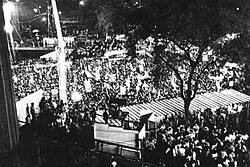
Anhagabau was also one of the sites of the biggest series of mass protests in Brazilian history. The "direitos já" (direct elections now!) where 1.5 million people gathered on April 16, 1984. (ok, this part from wikipedia. recite at your peril). This mobilization was one of the last straws in bringing down a 25-year military dictatorship. In fact, several older activists who have stopped by or encamped fondly remember this location. And, I think, everyone wants to see it filled again. As of yesterday, there are about 200 people. I am off to today's general assembly to see how things go today.
![]() |
| The Media Table. With Website and twitter hashtag. |
The rain came early Sunday morning, and the sixty campers (of which I was not) suspended most activities until around 1pm. In the meantime, an urgent call had gone out online asking for supplies--lots of food, a generator, 3G wireless connections, etc. When I arrived around 2:30pm, the food station was well under way, and my carrots, apples, oranges, bananas and limes joined a growing collection of staples and cooking supplies. The meditation group that was in session when I arrived slowly disbanded and a roda da batucada began to lead the group in AfroBrazilian communal dances. The poster group was working assiduously, painting messages on butcher paper, condemning the Belo Monte damn project, an initiative that will displace any number of indigenous peoples and destroy countless acres of virgen forest in the state of Pará, just north of Amazonas. These banners were being put up around the protest area, like the first posters an 18 year old gets when decorating her college dorm. And it had that feel too, of settling in and creating a space.
At once the securtiy whistle sounded as police had approached one side of the encampment and began absconding with the signs. A number of us rushed out ot the other side to grab the rest of the banners that were posted with sticks dugs into the Earth or hung from trees. Right now many of the banners are laying looking for a good home, where they won't be ripped down.
The encampment has ended up in the Valley of Anhagabau under the Vidauto do Cha (The Tea Bridge) quite by accident. The location committee had originally chosen a different location nearby, but the torrential conditions of the past two days forced the encampment under a bridge for shelter. The Valley of Anhagabau, however, is an auspicious location for this growing movement. Located in an expansive stretch of public park that is open to the air but sunk about 20 feet below ground level (it is after all a valley), the park sits at the base of one major subway line and a five minute walk from a second line. Although mostly abandoned during the weekend, the Valley and the surrounding area will be teeming with people during the weekday going to work and frequenting the various shopping areas. Preparations are underway for a major pamphletting iniative to draw attention to the occupation.
![]() |
| The Valley of Anhagabau, looking North. |
Anhagabau was also one of the sites of the biggest series of mass protests in Brazilian history. The "direitos já" (direct elections now!) where 1.5 million people gathered on April 16, 1984. (ok, this part from wikipedia. recite at your peril). This mobilization was one of the last straws in bringing down a 25-year military dictatorship. In fact, several older activists who have stopped by or encamped fondly remember this location. And, I think, everyone wants to see it filled again. As of yesterday, there are about 200 people. I am off to today's general assembly to see how things go today.
| Anhagabau, 1984. During the Diretos Já Protests. |
Thursday, September 1, 2011
Upper Class Eat Your Heart Out (Middle Class Eat Your Wallet)
Ever since I started coming to São Paulo, I have complained and duly noted the complaints of others about how expensive this city is, both in absolute terms and when compared to the rest of the country. Nowhere do people talk about high São Paulo prices than when talking about food services (and to a somewhat lesser extent transport). Now I know what you're going to say: "Jay, food prices are rising all over the world." Indeed they are. But if you go to the market or even to the grocery store, the food itself is not expensive. Brazilians often pride themselves on having a country where just about anything will grow. It is the price of eating out that has risen substantially. And this is true across all eating options--from prato feitos (think lunchtime diner food) to haute cuisine. The former category usually includes rice, beans, salad, and a meat. And up until a few years ago, it was reasonable to try to find something for around R$5 (at the time US$2.50- although the US-Brazil exchange rate has also tipped way in Brazil's favor and now R$5 is about US$3.80). Nowadays, you would be lucky (but maybe not hardpressed) to find a prato feito for under R$10, even in poor suburbs. As for high-end cuisine, a nice but nowhere near fancy meal will cost you minimum US$25, and top-end restaurants are as expensive as New York top-end restaurants. Although I have yet to drop US$100 on a meal, I hear that some upper-middle class people here to it like it's no big thing.
**Also, the other item that exceeds New York price rates?? Taxis.**
These rising prices, even in the middle of the Brazilian 'mini-miracle' (there ability to have respectable growth and low unemployment in the middle of a world financial crisis), is slowly coming to the attention of many of my middle class interlocutors. That is, amongst these people, my complaints are finally reciprocated. Despite and partially because of this, I was surprised to see a new study that seems to be making the rounds of Brazilian political media:
That the Brazilian lower-middle class (commonly referred to as Class C), eats more meals outside the home than Classes A or B (the middle and upper classes). A lot more. 55% of them eat lunch (remember those pratos feitos) outside the house. Of course, this makes sense as more working class jobs are entering the market but at sites that are farther and farther from working class neighborhoods. It's not uncommon to hear people complain of 3.5 hour commutes (one way) on inhumanely-packed public transit. Anybody who has the resources to 1. drive or 2. live closer to work (my option) probably does so, and ends up saving money on eating out. But the high property and rental prices due to speculation are also keeping people at home longer. This is all to say that the US$150 meal is not the scandal. It is the US$8 minimum to eat outside the house that is probably making São Paulo more unlivable for many people.
To end on a side note, I keep on wondering when brown bag lunches are going to come in style.
**Also, the other item that exceeds New York price rates?? Taxis.**
These rising prices, even in the middle of the Brazilian 'mini-miracle' (there ability to have respectable growth and low unemployment in the middle of a world financial crisis), is slowly coming to the attention of many of my middle class interlocutors. That is, amongst these people, my complaints are finally reciprocated. Despite and partially because of this, I was surprised to see a new study that seems to be making the rounds of Brazilian political media:
That the Brazilian lower-middle class (commonly referred to as Class C), eats more meals outside the home than Classes A or B (the middle and upper classes). A lot more. 55% of them eat lunch (remember those pratos feitos) outside the house. Of course, this makes sense as more working class jobs are entering the market but at sites that are farther and farther from working class neighborhoods. It's not uncommon to hear people complain of 3.5 hour commutes (one way) on inhumanely-packed public transit. Anybody who has the resources to 1. drive or 2. live closer to work (my option) probably does so, and ends up saving money on eating out. But the high property and rental prices due to speculation are also keeping people at home longer. This is all to say that the US$150 meal is not the scandal. It is the US$8 minimum to eat outside the house that is probably making São Paulo more unlivable for many people.
To end on a side note, I keep on wondering when brown bag lunches are going to come in style.
Monday, August 29, 2011
Reading The Fragile Present
On the 41st anniversary of the Stonewall Rebellion (June 28, 2011), I was invited to participate in a roundtable debate on the LGBT movement in Brazil—what we could learn from the past and what future challenges might be. It had, indeed, been a high-energy time for activists, who had mobilized several marches in São Paulo over a five month period, some of them reaching five thousand people. In addition to talking about the various problems facing LGBT people in São Paulo, several activists claimed that, contrary to a common sense opinion of progress, the movement was in a retrograde moment (um momento de retrocesso). Motivating several people to make this analysis was President Dilma Rousself’s declaration six weeks prior (mid-May 2011) that she was pulling a program to include an anti-homophobic education. The program “Education without Homophobia,” was the only program from a much larger agenda called “Brazil without Homophobia” to be put into action. Its veto from the president (and the politically suspect circumstances around that veto), left many LGBT activists disillusioned.
I had been hearing the politically fatalist talk in reaction to the veto of "Education without Homophobia" for quite some time. As an outside observer, I found it fascinating (and extremely relevant) that these same activists two weeks before the veto had been celebrating the unqualified success of the movement after the Supreme Court unanimously voted in favor of same-sex civil unions (May 4, 2011). As one activist told me during the spontaneous celebrations that followed the decisions, he felt that “anything was possible” and that we were embarking on a new phase of the movement. At the roundtable, I reminded people about this very short timeline between political elation and depression. I argued that the future is wildly unpredictable, and that we can hardly know whether we are in a moment of progress or retrograde. (Indeed, privately, I wondered about the validity of the terms).
How was it that peoples' collective understanding of the political present, of the historical moment in which the they were taking part, change so radically in such a short period of calendar time?
Some considerations (under the fold):
Saturday, July 9, 2011
30 Posts in 30 Days
I am taking a month off from the field which means (which should mean) more time for writing. Today, I am committing to averaging (and trying to stay on the rhythm of) one post per day. To be honest to myself, I won't count this post, which I just intended to announce (to myself) my project. I started this blog for two interrelated reasons: 1. to get into the habit of writing daily; 2. to get over the shame of writing, which is, essentially, the shame of sharing. So, even though only four or five people read my blog in any given month, the fact that I press publish at the end of each post teaches me to accept that no writing is perfect. But if I can share, then I can write. I can write because I can manage my fear of what people think about my writing.
I also hope that I can return to some of the early topics I advertised at the beginning of the blog-writing process and perhaps fulfill some promises (even if no one remembers that I made them). Up soon... VIP toilet paper.
Sunday, June 12, 2011
Gone Native
broadcasting from my old computer....
a picture of me in April at a protest against a Brazilian congressman who made homophobic, racist, and sexist comments. Hence the sticker that is stuck on my shirt, "We are all blacks, women, gays."
that sticker was a bear to get off too!
a picture of me in April at a protest against a Brazilian congressman who made homophobic, racist, and sexist comments. Hence the sticker that is stuck on my shirt, "We are all blacks, women, gays."
that sticker was a bear to get off too!
Thursday, May 19, 2011
It Wasn't Me
I like to take the Metro in São Paulo, but the congestion makes often makes it a very frustrating experience. São Paulo has some of the most crowded subways in the world....
I often find that I go on a sort of automatic pilot when I am on a particularly crowded subway car. I try to think of something else, but I also make sure that I know where my wallet is and that I will make my stop, which usually involves inching towards the door at least once stop prior.
Theories of the crowd emphasize the depersonalizing (Le Bon), imitative (Tarde) and tactile (Canetti) character of urban crowds. In other words, in a crowd one loses oneself to the sheer sensory overload (also called synaesthesia), and enters into collective behavior. My experience on these packed subways cars is that, yes, crowd sociality takes over, but that people often resist it like a young child fighting sleepiness. The packed subway car is a particularly dystopic kind of crowd, connected as it is to regimes of urban planning and wage labor that make crowded mass transit unpleasurable. Being on a packed subway car at noon is a very different experience than being packed in at a late night music venue (although some crumudgeons might beg to differ).
Read more about my adventures on the subway below the fold.
I often find that I go on a sort of automatic pilot when I am on a particularly crowded subway car. I try to think of something else, but I also make sure that I know where my wallet is and that I will make my stop, which usually involves inching towards the door at least once stop prior.
Theories of the crowd emphasize the depersonalizing (Le Bon), imitative (Tarde) and tactile (Canetti) character of urban crowds. In other words, in a crowd one loses oneself to the sheer sensory overload (also called synaesthesia), and enters into collective behavior. My experience on these packed subways cars is that, yes, crowd sociality takes over, but that people often resist it like a young child fighting sleepiness. The packed subway car is a particularly dystopic kind of crowd, connected as it is to regimes of urban planning and wage labor that make crowded mass transit unpleasurable. Being on a packed subway car at noon is a very different experience than being packed in at a late night music venue (although some crumudgeons might beg to differ).
Read more about my adventures on the subway below the fold.
Sunday, May 15, 2011
My week that was....
Apologies to those who don't speak Portuguese, but this is an amazing news mashup, and it is also a good lesson in how the public sphere operates and the slipperiness of signifiers from one news story to the next.
The first story is about how the banca evagenlica, or the Evangelical caucus in the Brazilian Congress has managed to block the addition of sexual orientation into Brazil's non-discrimination law. (This is also known as PLC 122, or the 'criminalization of homophobia.') The reporters have fun with the comments of far-right opposition to the bill calling it the beginning of an "imperialismo gay." The second story is about a protest that took second story is about the proposed metro stop for the 6th metro line (not scheduled to be built until 2020!) that was supposed to go through the rich neighborhood of higienopolis. In the video, a lot of rich residents explain how the metro stop would only bring potheads and criminals to their "traditional" neighborhood (because says one lady, these are the people who hang out at metro stops). Another lady in sunglasses (gotta love her), explains how, although her maid takes 3 busses to get to her house, people like her maid still don't know how to use a subway, so it wouldn't really help anyways. In response to this, a huge protest yesteday blocked the intersection in this neighborhood where the metro is supposed to go and had a hoedown for fabulous people (churrascão da gente diferenciada), where they made fun of these residents (and called them worse names then snobs). Note that the title of the video is called imperio gay vs. gente diferenciada, which shows how people consume stories like these together, and as part of a wider field of Brazilian class and sex politics. The other two stories are about the rising price of gasoline and the very controversial plan to open up more land in the Amazon to cattle raising (mostly for export to Russia and other fast developing economies).
Plus, they play "Common People" during the metro story. What's not to love!
The first story is about how the banca evagenlica, or the Evangelical caucus in the Brazilian Congress has managed to block the addition of sexual orientation into Brazil's non-discrimination law. (This is also known as PLC 122, or the 'criminalization of homophobia.') The reporters have fun with the comments of far-right opposition to the bill calling it the beginning of an "imperialismo gay." The second story is about a protest that took second story is about the proposed metro stop for the 6th metro line (not scheduled to be built until 2020!) that was supposed to go through the rich neighborhood of higienopolis. In the video, a lot of rich residents explain how the metro stop would only bring potheads and criminals to their "traditional" neighborhood (because says one lady, these are the people who hang out at metro stops). Another lady in sunglasses (gotta love her), explains how, although her maid takes 3 busses to get to her house, people like her maid still don't know how to use a subway, so it wouldn't really help anyways. In response to this, a huge protest yesteday blocked the intersection in this neighborhood where the metro is supposed to go and had a hoedown for fabulous people (churrascão da gente diferenciada), where they made fun of these residents (and called them worse names then snobs). Note that the title of the video is called imperio gay vs. gente diferenciada, which shows how people consume stories like these together, and as part of a wider field of Brazilian class and sex politics. The other two stories are about the rising price of gasoline and the very controversial plan to open up more land in the Amazon to cattle raising (mostly for export to Russia and other fast developing economies).
Plus, they play "Common People" during the metro story. What's not to love!
Saturday, May 14, 2011
The Impossibility of Imponderabilia
Before you assume too much from the title of this post, fear not. The impossibility of imponderabilia is not the end but the new beginning of this blog.
In March, I wrote that this blog would record the thoughts and observations I had on everyday life in São Paulo. I imagined that these observations would come from stolen moments, when and where the sheer enormity of life in a new location would foster acts of passive contemplation. I imagined that the mise-en-scenes that I would write here would work both with and against the ethnographic information that I was gathering in my "proper research." In contrast, I imagined this part of the ethnographic experience to be somewhat improper, counter-methodological, and hence somewhat illicit and exciting.
My ambiguous relationship towards imponderabilia is, of course, at the heart the of anthropological and ethnographic traditions. Imponderabilia, as I read Malinowski's advocation for it, is both the content that enfleshes social structure and the filter through which it becomes available. The only way out of imponderabilia was to give oneself over to it. As Malinowski envisioned, you sit around long enough in one place, and the world begins to unfold itself around you. Imponderabilia is thus less a methodology, and more a mobilization of aesthetic and epistemological first principles.*
Mobilizing imponderabilia seems to be more and more difficult in contemporary anthropology, working in post-industrial sites, and using modern methods. Urban anthropology, globalization, multi-sited and scale-jumping research, networks, media circulation, etc. appear to emphasize mobilities that require the anthropologist to chase after the site instead of remaining in it. Repeated in many forms, the new wisdom seems to be, the techniques anthropologists used in the village just won't work any more. To a large extent, I agree, and would add that we would be remiss to treat villiage-ify any of these sites instead of letting the mode of study emerge from the reconfigured site itself.
Nevertheless, I find it necessary to understand why impoderabilia fails in many contemporary ethnographic projects. And I want to take my own experiences as a point of reflection on this.
[More Under the Fold!]
In March, I wrote that this blog would record the thoughts and observations I had on everyday life in São Paulo. I imagined that these observations would come from stolen moments, when and where the sheer enormity of life in a new location would foster acts of passive contemplation. I imagined that the mise-en-scenes that I would write here would work both with and against the ethnographic information that I was gathering in my "proper research." In contrast, I imagined this part of the ethnographic experience to be somewhat improper, counter-methodological, and hence somewhat illicit and exciting.
My ambiguous relationship towards imponderabilia is, of course, at the heart the of anthropological and ethnographic traditions. Imponderabilia, as I read Malinowski's advocation for it, is both the content that enfleshes social structure and the filter through which it becomes available. The only way out of imponderabilia was to give oneself over to it. As Malinowski envisioned, you sit around long enough in one place, and the world begins to unfold itself around you. Imponderabilia is thus less a methodology, and more a mobilization of aesthetic and epistemological first principles.*
Mobilizing imponderabilia seems to be more and more difficult in contemporary anthropology, working in post-industrial sites, and using modern methods. Urban anthropology, globalization, multi-sited and scale-jumping research, networks, media circulation, etc. appear to emphasize mobilities that require the anthropologist to chase after the site instead of remaining in it. Repeated in many forms, the new wisdom seems to be, the techniques anthropologists used in the village just won't work any more. To a large extent, I agree, and would add that we would be remiss to treat villiage-ify any of these sites instead of letting the mode of study emerge from the reconfigured site itself.
Nevertheless, I find it necessary to understand why impoderabilia fails in many contemporary ethnographic projects. And I want to take my own experiences as a point of reflection on this.
[More Under the Fold!]
Tuesday, April 12, 2011
mea desculpa
First, many appologies for the absence. In the past week, I have had to renew my visa, rescue data from a computer suffering a slow crash, and do my taxes on a first generation eee-pc with the computing power of an one laptop per child and the screen size of an iphone.
All of this means that I am going to try to do smaller posts for the next week, as I await my mildly overpriced, mildly undercomputing netbook to arrive in the mail.
Sunday, April 3, 2011
The Romance of Activism
After sitting in on a couple activist meetings this week, I came to two realizations. First, I could make my entire dissertation project about queer and related activism in São Paulo. Instead of consistently feeling guilty for not making x, y meeting because of a conflict with work (like I do in Chicago), I could just make my work consist of going to meetings and protests. We'll see if that actually pans out. If so, I will have to up the before bed stretching to compensate for the time spent in uncomfortable chairs for four hours a pop.
Second, I realized that activist collectives resemble romantic relationships in all the good and all the bad senses. During a particularly tense session last week, I kind of zoned out and started writing scribbling the following in English....
"In meetings, we argue with our fellow activists because we feel a love for the world we want to create and share with one another. But, we have to remember, like all lovers, we have different styles of love. Some of us are generous, others selfish. Some love to argue, and some withdraw. Some of us are pragmatists and others idealists. Part of the challenge of the affective life of meetings is accepting our lovers' demands of us, and the various kinds of care we must offer to one another... of listening to the person who needs to be listened to, of arguing until we get the fight out of us, and of just letting other subjects go ... of sometimes making quality time for one another and other times giving one another space ... of working through difficult problems for worthwhile causes and camaraderie, and knowing when to finish others. And, to learn to live with disillusionment and keep acting out of love."
Second, I realized that activist collectives resemble romantic relationships in all the good and all the bad senses. During a particularly tense session last week, I kind of zoned out and started writing scribbling the following in English....
"In meetings, we argue with our fellow activists because we feel a love for the world we want to create and share with one another. But, we have to remember, like all lovers, we have different styles of love. Some of us are generous, others selfish. Some love to argue, and some withdraw. Some of us are pragmatists and others idealists. Part of the challenge of the affective life of meetings is accepting our lovers' demands of us, and the various kinds of care we must offer to one another... of listening to the person who needs to be listened to, of arguing until we get the fight out of us, and of just letting other subjects go ... of sometimes making quality time for one another and other times giving one another space ... of working through difficult problems for worthwhile causes and camaraderie, and knowing when to finish others. And, to learn to live with disillusionment and keep acting out of love."
Friday, April 1, 2011
Sad Education: Why the Brazilian Public Will Need to Slap Down One of Its Representatives
We interrupt the previously scheduled post for a breaking announcement....
This weekend, I will participate in a protest to demand the cassação (roughly analogous to impeachment proceedings) for a Federal deputado (Congress member), Jair Bolsonaro. Bolsonaro caused massive outrage for his racist, homophobic and pro-dictatorial comments in a March 28 interview on TV Bandeirante's popular program CQC [think Daily Show + Upright Citizen's Brigade].
To review, Bolsonaro's previous comments provided the necessary tinder to ignite a fire amongst activists and the broader public. But in the four short days after this latest interview, the public and media response has been swift and overwhelming. CQC's blog has been taken over by this media story, with responses from Bolsonaro, counter-responses, and even a call to action. And if Bolsonaro is successfully impeached, it will be the first time (I think) that a public official in Brazil has been removed from office for something they said. This might strike American's first ammendment sensibilities as a scary proposition. In fact, I am a little torn on the matter. Nevertheless, it has been interesting for me to observe how Brazilians consider such injurious speech (to borrow Judith Butler's term) as either a potential harm or delegitimation of a democratic and egalitarian civil society.
I first heard about the new, controversial interview with Bolsonaro from my roommate, who mentioned it during our dinner conversation on Wednesday night (remember broadcast on Monday). On Thursday morning, I opened my facebook to see an invitation to demand Bolsonaro's cassação. At the time of writing, another facebook group has amassed 40,000 members demanding an investigation. The subject came up Thursday night at an LGBT advocacy meeting, where a member of the group said: "we have to respond to this. Other organizations are responding. We have to link up." And this morning (Friday), I received multiple invitations to a protest against Bolsonaro taking place Sunday on Paulista Avenue. What struck me as a media story and political movement has been the rapidity of the information cycle. On Wednesday, I received one piece of information, on Thursday five, and today the response is overwhelming. It is also pretty amazing to observe the experiential difference of being inside vs. outside of the production of a media story. That is, as you consume more media on a particular story you become psychically invested in it in a way that distinguishes you from those who aren't. This kind of psychic investment and the overwhelming stimuli involved in the news cycle strikes me as distinct from Michael Warner's instant-classic description of counterpublics. For Warner, the pull to new counterpublic worlds is predicated upon a concatenation of addresses that circulate with regularity. The news cycle (particularly the political news cycle), is based upon an entirely different rhythm, where people aren't creating worlds but catching up to them.
More on what Bolsonaro said below
This weekend, I will participate in a protest to demand the cassação (roughly analogous to impeachment proceedings) for a Federal deputado (Congress member), Jair Bolsonaro. Bolsonaro caused massive outrage for his racist, homophobic and pro-dictatorial comments in a March 28 interview on TV Bandeirante's popular program CQC [think Daily Show + Upright Citizen's Brigade].
To review, Bolsonaro's previous comments provided the necessary tinder to ignite a fire amongst activists and the broader public. But in the four short days after this latest interview, the public and media response has been swift and overwhelming. CQC's blog has been taken over by this media story, with responses from Bolsonaro, counter-responses, and even a call to action. And if Bolsonaro is successfully impeached, it will be the first time (I think) that a public official in Brazil has been removed from office for something they said. This might strike American's first ammendment sensibilities as a scary proposition. In fact, I am a little torn on the matter. Nevertheless, it has been interesting for me to observe how Brazilians consider such injurious speech (to borrow Judith Butler's term) as either a potential harm or delegitimation of a democratic and egalitarian civil society.
I first heard about the new, controversial interview with Bolsonaro from my roommate, who mentioned it during our dinner conversation on Wednesday night (remember broadcast on Monday). On Thursday morning, I opened my facebook to see an invitation to demand Bolsonaro's cassação. At the time of writing, another facebook group has amassed 40,000 members demanding an investigation. The subject came up Thursday night at an LGBT advocacy meeting, where a member of the group said: "we have to respond to this. Other organizations are responding. We have to link up." And this morning (Friday), I received multiple invitations to a protest against Bolsonaro taking place Sunday on Paulista Avenue. What struck me as a media story and political movement has been the rapidity of the information cycle. On Wednesday, I received one piece of information, on Thursday five, and today the response is overwhelming. It is also pretty amazing to observe the experiential difference of being inside vs. outside of the production of a media story. That is, as you consume more media on a particular story you become psychically invested in it in a way that distinguishes you from those who aren't. This kind of psychic investment and the overwhelming stimuli involved in the news cycle strikes me as distinct from Michael Warner's instant-classic description of counterpublics. For Warner, the pull to new counterpublic worlds is predicated upon a concatenation of addresses that circulate with regularity. The news cycle (particularly the political news cycle), is based upon an entirely different rhythm, where people aren't creating worlds but catching up to them.
More on what Bolsonaro said below
Monday, March 28, 2011
The City as Fantasy and Reality Principle
[NOTE: This is still a draft, and the content will probably change in the next couple days].
This is the first of two reviews of recent queer/ish films I watched that take place in São Paulo.
The first movie is called Quanto Dura O Amor, literally translated as ‘How Long Does Love Last?’ but released internationally in English as Paulista. The movie’s English-language title hits upon a zeitgeist that is so trenchant in the film that it is probably too obvious for the Brazilian viewer. That is, how Avenida Paulista is the symbol of modernity in São Paulo and Brazil. There is a lot I could say about Av. Paulista and its geographic and symbolic importance in cultural politics, perhaps even a chapter’s worth. What I want to talk about here is how the geography of the city mobilizes intertwined fantasies of professional fulfillment, romantic yearning, and quasi-existential happiness, while simultaneously putting those fantasies just out of reach. Paulista teaches the viewer how to love suffering for one’s aspirations.
Here is the trailer with English subtitles.
The movie follows the romantic lives of three characters living in a no-frills apartment complex at the very end of the Paulista. Humble abodes with a view to die for. The film begins with Marina leaving her boyfriend and her country accent behind, as she drives to São Paulo to try and land a part as a stage actress. Through some interpersonal connections, she has managed to find an open room in legal-assistant Suzana’s apartment. As Marina discovers the building’s community terrace, she exclaims to another resident, Jay, how she can’t believe her new address. “Could you imagine if someone asked me where I live? Man, I’d tell them, ‘on the Paulista.’”
Warning: Minor Spoilers Beneath the Fold.
Wednesday, March 23, 2011
Different Stokes for Different Folks
Tonight over dinner, I told my roommate that we have a phrase in the U.S., and then I gave a rough translation of:
"You dance with the devil, the devil doesn't change."
She smiled and turned her eyes up to the ceiling. "Ahh," she replied, "in Brazil we say...
"se está no inferno, abraça o capeta."
or, "When in hell, embrace the demon."
Touché
"You dance with the devil, the devil doesn't change."
She smiled and turned her eyes up to the ceiling. "Ahh," she replied, "in Brazil we say...
"se está no inferno, abraça o capeta."
or, "When in hell, embrace the demon."
Touché
Monday, March 21, 2011
Atendimento, or "Have You Been Served?" São Paulo Style
Today's post is inspired by the many offices I visited today.
If you are asked one question while you are in São Paulo, it is likely to be the following:
"O/a senhor/a já foi atendindo?" ["Has the gentleman/lady been served/attended to?"]
One friend who grew up in Brasilia, the capital, joked that atendimento is a very São Paulo social artifice. Being attended to, in the most traditional scenario, involves arriving at an office and being immediately greeted by a receptionist. This receptionist or assistant will offer you coffee, which they will not bring. Rather, another cleaning/kitchen assistant is chamado [called] to bring you an espresso or water. And often the receptionist will take coffee with you, while you both wait for the receptionist's boss to become available. Being attended to gives the office visitor a sense of social status and esteem. Of course, not as much status or esteem as the boss who is too busy to see you at the mutually-agreed upon time. Atendimento is, thus, a social mediation of sorts between senhores [gentlemen].
As the consumer and service economies have expanded rapidly, so has the practice of atendimento and the pretensions to treat every client as a gentleman or lady. Last week, as I was shopping for a mattress, one salesman encouraged me to sit down so we could discuss the price, and motioned for another saleswoman to bring me coffee. What was particularly interesting about this encounter (beyond the gender dynamic that played out), was that this store had some of the lower-end mattresses and prices that I had visited that day. In effect, its atendimento practice was more self-consciously aspirational and over-compensatory than 'second nature.' Also, good atendimento over the phone is seen as a requisite business practice. No customer or client complaint is as damning as: 'eu fui mal atendido.' [I was poorly served.]
More under the fold
If you are asked one question while you are in São Paulo, it is likely to be the following:
"O/a senhor/a já foi atendindo?" ["Has the gentleman/lady been served/attended to?"]
One friend who grew up in Brasilia, the capital, joked that atendimento is a very São Paulo social artifice. Being attended to, in the most traditional scenario, involves arriving at an office and being immediately greeted by a receptionist. This receptionist or assistant will offer you coffee, which they will not bring. Rather, another cleaning/kitchen assistant is chamado [called] to bring you an espresso or water. And often the receptionist will take coffee with you, while you both wait for the receptionist's boss to become available. Being attended to gives the office visitor a sense of social status and esteem. Of course, not as much status or esteem as the boss who is too busy to see you at the mutually-agreed upon time. Atendimento is, thus, a social mediation of sorts between senhores [gentlemen].
As the consumer and service economies have expanded rapidly, so has the practice of atendimento and the pretensions to treat every client as a gentleman or lady. Last week, as I was shopping for a mattress, one salesman encouraged me to sit down so we could discuss the price, and motioned for another saleswoman to bring me coffee. What was particularly interesting about this encounter (beyond the gender dynamic that played out), was that this store had some of the lower-end mattresses and prices that I had visited that day. In effect, its atendimento practice was more self-consciously aspirational and over-compensatory than 'second nature.' Also, good atendimento over the phone is seen as a requisite business practice. No customer or client complaint is as damning as: 'eu fui mal atendido.' [I was poorly served.]
More under the fold
Sunday, March 20, 2011
Over, Under, and Through
The other day, I walked from São Paulo's Museum of Modern Art (MASP) to the 9 de julho viaduct, via the 9 de julho Avenue. It's about a 1.6 km walk, which is a small portion compared to the entire stretch of 9 de julho that extends from Anhagabau Valley to the Pinheiros river (about 10 km total). 9 de Julho Avenue has expanded immensely over the twentieth century. It was originally widened to a boulevard with expansive sidewalks. Then (I imagine in the 1970s), the city diminished the width of the sidewalks to make 9 de julho an arterial avenue. In the 1930s, the Daher Elias Cutait tunnel was inaugurated which sent the 9 de julho underground for half a kilometer. In the 1990s, express bus lanes were put in the middle of the arterial. With so many lanes and so much traffic, walking is definitely secondary. Yet residential apartments line both sides of this section of 9 de julho. Most of them were probably built before the sidewalk was reduced, and many of them have built garages where possible. But pedestrians spring up along this route like daisies through cement. Cars, busses, over and underpasses, and gated buildings cannot keep them from going about their daily lives.
Pictures:
The view from behind the Modern Art Museum of São Paulo of residential buildings that line either side of the avenue. I am currently standing several stories above the underground tunnel and the avenue.
I begin my descent onto the avenue. It is hard to note here, but at the bottom of the photograph is a colonnaded observation deck built with the tunnel that has now been closed to the public.
This is a photograph of the entry to the tunnel, when it was first constructed. Notice the observation level above the arches and the wide sidewalk at the base of the tunnel entry.
Now, the sidewalk has been reduced, and there is another viaduct that passes over the entrance to the tunnel.
Pictures:
The view from behind the Modern Art Museum of São Paulo of residential buildings that line either side of the avenue. I am currently standing several stories above the underground tunnel and the avenue.I begin my descent onto the avenue. It is hard to note here, but at the bottom of the photograph is a colonnaded observation deck built with the tunnel that has now been closed to the public.
This is a photograph of the entry to the tunnel, when it was first constructed. Notice the observation level above the arches and the wide sidewalk at the base of the tunnel entry.
Now, the sidewalk has been reduced, and there is another viaduct that passes over the entrance to the tunnel.
Monday, March 14, 2011
Look What I Wrote On My Shirt
Welcome to my new blog, dedicated to my observations of everyday life in São Paulo. My name is Jay Sosa, and I am a PhD student in sociocultural anthropology. I am currently conducting research in São Paulo, Brazil on (1) how LGBT activists and businesses utilize urban space and mass media circulation to generate publicity and (2) how such publicity affects the lives of LGBT people in the city. In order to conduct this research, I am using a technique called “ethnography,” where I will live in my “fieldsite” (i.e. São Paulo), participate in and observe organizations that charge themselves with generating such publicity. I will also interview and interact with large swaths of people in São Paulo to see what effects (if any) these organizations have.
Ethnography has been called by anthropologist Clifford Geertz as “deep hanging out,” and earlier by anthropologist Brosinow Malinowski as an attempt to record the “imponderabilia of everyday life.” By ‘imponderabilia,’ Malinowski means the innumerable cultural facts, understandings and interpretations that shade any event with a particular meaning. He calls these underlying understandings ‘imponderabilia’ precisely because they are too immense and too subtle to catalogue and delineate. For Malinowski, the best way to analyze a social phenomenon is to grasp it in all its detail and adjoining context and witness it as it occurs and where it occurs. That is, ethnography is something you do in situ, and the ethnographer’s knowledge about impoderabilia is acquired over (or unfolds through) time.
The real shame of trying to capture everyday life and its imponderabilia is that one ends up observing and thinking about much more than one’s research subject proper. Or, put another way, one ends up amassing too much contextual information than could ever be fully expounded upon in a research paper or book. That is where this blog comes in (for me). I plan to write about things that may seem totally unrelated to the research objectives I outlined above. Nevertheless, in keeping with the theme of imponderabilia, such details may provide crucial details in trying to explain why my observations of LGBT publicity are ethnographically important.
And, this is where I will rely on you, dear reader, for your attention and your responsiveness. During the month or so that I have been here, many everyday minutia have piqued my interest. And I will be sharing these things in the coming days, weeks, and months. But I also want to know what piques your interest too. What should I seek out? What is worth exploring more? What do you want to know?
Many of my initial thoughts have to do with the city’s architecture, since a large part of my three weeks here were spent walking around parts of the city. The next few posts will most likely include:
Sidewalks (I mean, it’s the title of the blog right)
Municipal parks
Shopping Arcades (yes, São Paulo still has a few, and yes, I have pretensions of being Walter Benjamin)
VIP (pronounced ‘veepey’) culture
Bicycles
Subway Expansion
Sound Pollution
Laundry and the Middle Class
Subscribe to:
Posts (Atom)