So, one of the things that we anthropologists try to figure out is how certain categories are understood by the communities in which we work and how they enable and constrain social relations. The traditional term for this is finding out the "native categories." There are tons of critiques of working through native categories and the idea that understanding the meanings of certain concepts unlocks indigineous understandings, etc. But let's leave that aside for now. One of the largest challenges of engaging native categories is trying to utilize and explain them to people who have different worldviews and taxonomies without doing violence to the integrity of the original concept.
So, I have been trying to figure out exactly what the category of playboy or playboyzinho (little playboy) meant to people. I first heard it at a protest for a new metro stop in a rich neighborhood who didn't want more public transit that would bring the 'wrong type.' At this protest, I heard people shout, "Ey, playboy, vai tomar no cu." (Hey Playboy, go fuck yourself up the ass). At this point, I understood playboys to be a kind of privileged guy whose parents buy him anything he wants, and who acts like he owns the world. So, in my head, I immediately envision some kind of Monte plays tennis with Buffy type. Talk about native categories, how about my own, right.
So, I was told that it was a much more broader critique of priveleged middle class youth. (ok, so less Monte aristocratic, more braugh-style middle class culture). Flash forward, I am giving a talk on protests, aesthetics, and solidarity. I use the example of how a group who I describe as "anarchist fratboys" are learning to demasculinize and de-heteteronormativize their protest chants. Now, instead of saying "ey, [insert politician] vai tomar no cu," they say "ey, [politician] vai tomar no cum, é bom!." [Hey, politician, take it up the ass, it's good!"]. It's a good ethnographic example, except that I don't know how to translate protesters that I understand as kind of fratty (with all the masculine culture that I associate with that) into portuguese. So, I translate "anarchist fratboy" into "playboyzinho anarchista."
Needless to say, I get reamed in the comments, and, in retrospect, justly so. These anarchists are middle class, I am told, but they are hardly playboys. I think I had underestimated just how negative a connotation playboy has, especially by people who consider themselves leftists. So, now I think I have to find a new name for many of these people, who are not quite my interlocutors but ar elinked to them.
On the one hand, I have this problem of translating my own native categories (fratboy) into Portuguese and trying to understand what playboy signifies in any given situation. I want to write more (in the near future) about a problem I am having with people describing the agressors in cases of homophobic violence in terms of ideology/culture without an eye towards socioeconomics. For instance, people are very critical of skinhead attacks (rightly so) against LGBT people. But they don't recognize the class aspect of these skinheads who often come from poor neighborhoods. Likewise, I am hearing more reports of gay people in rich neighborhoods being attacked by playboys. And people have an automatic rationalization that playboys são escrotos. (Playboys are arrogant assholes). But what does it mean that these rich kids feel like they can pick on vulnerable people for enjoyment. I think there is a lot more disentangling here to do.
Friday, October 28, 2011

Thursday, October 27, 2011
Pass me that Proprietary Eponym (transnational edition)
I was at the counter of a lanchonete (a fastfood place that specializes in small savory snacks or salgados, coffee, sandwhiches, cakes, and juices) yesterday enjoying a coxinha de frango and a coffee with milk, in a working class/poor neighborhood in central São Paulo. The next guy to the counter comes up and asks the elderly man attending the counter for a "beekee." The old man looks at me, but I have no clue what the guy is asking. The old man says, "não entendi," [I didn't understand] still looking at me. I respond "eu também não" [I didn't either]. The guy who asked for the "beekee" looks frustrated. "Vc não tem esquero grande?" [You don't have a big lighter, do you?] "Ahhh," guy behind the counter says and I think to myself at the same time. It turned out the lanchonete did, in fact, have lighters.
So, if you didn't catch this, the guy asked for a Bic (as in the lighter brand), using Portuguese pronunciation rules. In addition to feeling proud that the guy behind the counter consulted me to figure out if he understand correctly, I thought it was interesting what gets turned into a proprietary eponym (e.g. aspirin, kleenex, jello), varies in transnational contexts.
anyways, thought of the day...
So, if you didn't catch this, the guy asked for a Bic (as in the lighter brand), using Portuguese pronunciation rules. In addition to feeling proud that the guy behind the counter consulted me to figure out if he understand correctly, I thought it was interesting what gets turned into a proprietary eponym (e.g. aspirin, kleenex, jello), varies in transnational contexts.
anyways, thought of the day...
Monday, October 24, 2011
No, you do want to move. You just don't know it yet.
I am almost always frustrated by the apparent lack of organization in the São Paulo subway and on escalators in general. How can a city of sixteen million people not follow the simple stand-on-right/pass-on-left rule. I've complained about this to many paulistanos, and they tell me more or less the same thing. Even though they are paulistanos, and given to stress and hurry, they are still Brazilians, and thus, not given to organization. I reject this reasoning, since I think it represents a form of "brazil is backwards" ressentiment. In fact there does seem to be a right/left-stand/pass structure. The problem is about 60% of the people ignore it and just stand on the escalator on either side, and about 40% of people become horribly resigned to wait.
Today, however, I experienced a ray of light to this situation. An opening if you will. As I was going down the excalator into the subway, there was a couple in their twenties not doing much of anything but blocking anyone from passing them. A small women, also in her late twenties and wearing sunglasses, said to the girl on the left: "moça, vc não quer permitir as pessoas passarem?" <Hey girl, don't you want to let people get past you?> So, the translation is rough. In reality, you have to hear the intonation (which I tried to register with the question mark) to get that this statement is typically Brazilian. Sort of aggressive (almost rude) in its directness but said in such a sing-song way as to sound quite sweet. In fact, the girl in the couple was kind of surprised that someone would make this request, but quickly stepped over to the right, where her boyfriend was. The girl in the sunglasses quickly shot past them, and I followed the girl in sunglasses. When I got to the bottom of the excalator, I looked back up. The couple returned to their original positions, and the person who had been behind me was patiently waiting to get by.
So, change is a long time coming. But if I have the chutzpah, I am going to try this move in the future.
Today, however, I experienced a ray of light to this situation. An opening if you will. As I was going down the excalator into the subway, there was a couple in their twenties not doing much of anything but blocking anyone from passing them. A small women, also in her late twenties and wearing sunglasses, said to the girl on the left: "moça, vc não quer permitir as pessoas passarem?" <Hey girl, don't you want to let people get past you?> So, the translation is rough. In reality, you have to hear the intonation (which I tried to register with the question mark) to get that this statement is typically Brazilian. Sort of aggressive (almost rude) in its directness but said in such a sing-song way as to sound quite sweet. In fact, the girl in the couple was kind of surprised that someone would make this request, but quickly stepped over to the right, where her boyfriend was. The girl in the sunglasses quickly shot past them, and I followed the girl in sunglasses. When I got to the bottom of the excalator, I looked back up. The couple returned to their original positions, and the person who had been behind me was patiently waiting to get by.
So, change is a long time coming. But if I have the chutzpah, I am going to try this move in the future.
Wednesday, October 19, 2011
The New Shop Economy
Today, I went to Santo Amaro, in the Southern part of the city. Many consider this part of the city the periphery, even though it's fairly well-served by public transit (I arrived by subway) and it's bustling with stores. I was on my way to the sub-prefeitura (neighborhood council?, literally the city hall for the subsection of the city), but I managed to snap a few shops of the insane number of clothing shops that I passed in the two blocks between the subway and the sub-prefeitura.
These shops, the aesthetics of mass produced undies, shoes, and jeans are not new by any means. But their quantity, to me, seems kind of unprecedented. Perhaps enough of a quantitative shift to constitute a qualitative shift. These are the kinds of goods, or this is the kind of economy, that many say are undergirding the unseasonable prolonged growth of the Brazilian economy. The increased purchasing power of the Brazilian working and lower-middle class, financed by Lula welfare-state reforms, is increasingly demanding cheap goods that would have been considered luxuries a generation ago. These items are flooding in through ever-increasing trade with China. These two factors, increasing lower-middle class consumption and an economy increasingly linked with China and Russia and not the U.S. and Europe, is sustaining Brazil in the midst of world economic crisis.
It is highly ironic that many of the São Paulo elite and middle classes avoid such neighborhoods as "dirty"and "dangerous." On top of being extremely prejudice and factually incorrect, such a viewpoint denies the reality that these neighborhoods and economies are responsible for Brazil's current economic mini-miracle. And they are some of the only (or last) places in São Paulo where the commons function. While grabbing a kibe (middle eastern beef roll that has become as Paulistano as...pizza) at the local snack bar, I was talking with a guy who lives in Moema (a very well-to-do neighboorhood in the region), but prefers to hang out in Santo Amaro. To him, Moema always seems empty. No one is on the street. All one sees are cars leaving their high-rise garages. These are the high security neighborhoods that Teresa Caldeira discusses in City of Walls. But Santo Amaro is bustling. At noon, it teems with people eating and shopping on the streets. And that is why this guy comes here to hang out and drink a beer.
Ok, some photos.

More here...For a Woman thinking really hard about shoes, follow the jump!
These shops, the aesthetics of mass produced undies, shoes, and jeans are not new by any means. But their quantity, to me, seems kind of unprecedented. Perhaps enough of a quantitative shift to constitute a qualitative shift. These are the kinds of goods, or this is the kind of economy, that many say are undergirding the unseasonable prolonged growth of the Brazilian economy. The increased purchasing power of the Brazilian working and lower-middle class, financed by Lula welfare-state reforms, is increasingly demanding cheap goods that would have been considered luxuries a generation ago. These items are flooding in through ever-increasing trade with China. These two factors, increasing lower-middle class consumption and an economy increasingly linked with China and Russia and not the U.S. and Europe, is sustaining Brazil in the midst of world economic crisis.
It is highly ironic that many of the São Paulo elite and middle classes avoid such neighborhoods as "dirty"and "dangerous." On top of being extremely prejudice and factually incorrect, such a viewpoint denies the reality that these neighborhoods and economies are responsible for Brazil's current economic mini-miracle. And they are some of the only (or last) places in São Paulo where the commons function. While grabbing a kibe (middle eastern beef roll that has become as Paulistano as...pizza) at the local snack bar, I was talking with a guy who lives in Moema (a very well-to-do neighboorhood in the region), but prefers to hang out in Santo Amaro. To him, Moema always seems empty. No one is on the street. All one sees are cars leaving their high-rise garages. These are the high security neighborhoods that Teresa Caldeira discusses in City of Walls. But Santo Amaro is bustling. At noon, it teems with people eating and shopping on the streets. And that is why this guy comes here to hang out and drink a beer.
Ok, some photos.
 |
| Torsoless mannequins and bored retail workers. |

 |
| Piles and piles of underwear. |
More here...For a Woman thinking really hard about shoes, follow the jump!
Tuesday, October 18, 2011
More photos of Acampa Sampa!
Last night there was a proposal to rename the movement, but I couldn't stay that long during the general assembly (I'm a bad participant democrater). Anyways, some photos over the last three days. Captions soon to follow. Follow what's going on (in portuguese, for now) at 15o.org, #acampasampa


Holy Civil Disobedience batman! more pics under the fold


Holy Civil Disobedience batman! more pics under the fold
Monday, October 17, 2011
Acampa Sampa!
A partial account of Day 2 of Occupy São Paulo / 15-O SP. (Still setting on a name).
The rain came early Sunday morning, and the sixty campers (of which I was not) suspended most activities until around 1pm. In the meantime, an urgent call had gone out online asking for supplies--lots of food, a generator, 3G wireless connections, etc. When I arrived around 2:30pm, the food station was well under way, and my carrots, apples, oranges, bananas and limes joined a growing collection of staples and cooking supplies. The meditation group that was in session when I arrived slowly disbanded and a roda da batucada began to lead the group in AfroBrazilian communal dances. The poster group was working assiduously, painting messages on butcher paper, condemning the Belo Monte damn project, an initiative that will displace any number of indigenous peoples and destroy countless acres of virgen forest in the state of Pará, just north of Amazonas. These banners were being put up around the protest area, like the first posters an 18 year old gets when decorating her college dorm. And it had that feel too, of settling in and creating a space.

At once the securtiy whistle sounded as police had approached one side of the encampment and began absconding with the signs. A number of us rushed out ot the other side to grab the rest of the banners that were posted with sticks dugs into the Earth or hung from trees. Right now many of the banners are laying looking for a good home, where they won't be ripped down.
The encampment has ended up in the Valley of Anhagabau under the Vidauto do Cha (The Tea Bridge) quite by accident. The location committee had originally chosen a different location nearby, but the torrential conditions of the past two days forced the encampment under a bridge for shelter. The Valley of Anhagabau, however, is an auspicious location for this growing movement. Located in an expansive stretch of public park that is open to the air but sunk about 20 feet below ground level (it is after all a valley), the park sits at the base of one major subway line and a five minute walk from a second line. Although mostly abandoned during the weekend, the Valley and the surrounding area will be teeming with people during the weekday going to work and frequenting the various shopping areas. Preparations are underway for a major pamphletting iniative to draw attention to the occupation.
Anhagabau was also one of the sites of the biggest series of mass protests in Brazilian history. The "direitos já" (direct elections now!) where 1.5 million people gathered on April 16, 1984. (ok, this part from wikipedia. recite at your peril). This mobilization was one of the last straws in bringing down a 25-year military dictatorship. In fact, several older activists who have stopped by or encamped fondly remember this location. And, I think, everyone wants to see it filled again. As of yesterday, there are about 200 people. I am off to today's general assembly to see how things go today.
 |
| The Media Table. With Website and twitter hashtag. |
The rain came early Sunday morning, and the sixty campers (of which I was not) suspended most activities until around 1pm. In the meantime, an urgent call had gone out online asking for supplies--lots of food, a generator, 3G wireless connections, etc. When I arrived around 2:30pm, the food station was well under way, and my carrots, apples, oranges, bananas and limes joined a growing collection of staples and cooking supplies. The meditation group that was in session when I arrived slowly disbanded and a roda da batucada began to lead the group in AfroBrazilian communal dances. The poster group was working assiduously, painting messages on butcher paper, condemning the Belo Monte damn project, an initiative that will displace any number of indigenous peoples and destroy countless acres of virgen forest in the state of Pará, just north of Amazonas. These banners were being put up around the protest area, like the first posters an 18 year old gets when decorating her college dorm. And it had that feel too, of settling in and creating a space.
 |
| hmm, I can't read the last word, but it looks like it says. "Xingu is life, Belo Monte is Death." Xingu is an indigenous group that will be horribly affected by the Belo Monte damn. A group of Xingu activists were in town to protest the damn and ended up joining the encampment. |
At once the securtiy whistle sounded as police had approached one side of the encampment and began absconding with the signs. A number of us rushed out ot the other side to grab the rest of the banners that were posted with sticks dugs into the Earth or hung from trees. Right now many of the banners are laying looking for a good home, where they won't be ripped down.
The encampment has ended up in the Valley of Anhagabau under the Vidauto do Cha (The Tea Bridge) quite by accident. The location committee had originally chosen a different location nearby, but the torrential conditions of the past two days forced the encampment under a bridge for shelter. The Valley of Anhagabau, however, is an auspicious location for this growing movement. Located in an expansive stretch of public park that is open to the air but sunk about 20 feet below ground level (it is after all a valley), the park sits at the base of one major subway line and a five minute walk from a second line. Although mostly abandoned during the weekend, the Valley and the surrounding area will be teeming with people during the weekday going to work and frequenting the various shopping areas. Preparations are underway for a major pamphletting iniative to draw attention to the occupation.
 |
| The Valley of Anhagabau, looking North. |
Anhagabau was also one of the sites of the biggest series of mass protests in Brazilian history. The "direitos já" (direct elections now!) where 1.5 million people gathered on April 16, 1984. (ok, this part from wikipedia. recite at your peril). This mobilization was one of the last straws in bringing down a 25-year military dictatorship. In fact, several older activists who have stopped by or encamped fondly remember this location. And, I think, everyone wants to see it filled again. As of yesterday, there are about 200 people. I am off to today's general assembly to see how things go today.
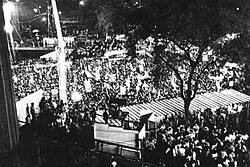 |
| Anhagabau, 1984. During the Diretos Já Protests. |
Subscribe to:
Posts (Atom)