 |
| The Media Table. With Website and twitter hashtag. |
The rain came early Sunday morning, and the sixty campers (of which I was not) suspended most activities until around 1pm. In the meantime, an urgent call had gone out online asking for supplies--lots of food, a generator, 3G wireless connections, etc. When I arrived around 2:30pm, the food station was well under way, and my carrots, apples, oranges, bananas and limes joined a growing collection of staples and cooking supplies. The meditation group that was in session when I arrived slowly disbanded and a roda da batucada began to lead the group in AfroBrazilian communal dances. The poster group was working assiduously, painting messages on butcher paper, condemning the Belo Monte damn project, an initiative that will displace any number of indigenous peoples and destroy countless acres of virgen forest in the state of Pará, just north of Amazonas. These banners were being put up around the protest area, like the first posters an 18 year old gets when decorating her college dorm. And it had that feel too, of settling in and creating a space.
 |
| hmm, I can't read the last word, but it looks like it says. "Xingu is life, Belo Monte is Death." Xingu is an indigenous group that will be horribly affected by the Belo Monte damn. A group of Xingu activists were in town to protest the damn and ended up joining the encampment. |

At once the securtiy whistle sounded as police had approached one side of the encampment and began absconding with the signs. A number of us rushed out ot the other side to grab the rest of the banners that were posted with sticks dugs into the Earth or hung from trees. Right now many of the banners are laying looking for a good home, where they won't be ripped down.
The encampment has ended up in the Valley of Anhagabau under the Vidauto do Cha (The Tea Bridge) quite by accident. The location committee had originally chosen a different location nearby, but the torrential conditions of the past two days forced the encampment under a bridge for shelter. The Valley of Anhagabau, however, is an auspicious location for this growing movement. Located in an expansive stretch of public park that is open to the air but sunk about 20 feet below ground level (it is after all a valley), the park sits at the base of one major subway line and a five minute walk from a second line. Although mostly abandoned during the weekend, the Valley and the surrounding area will be teeming with people during the weekday going to work and frequenting the various shopping areas. Preparations are underway for a major pamphletting iniative to draw attention to the occupation.
 |
| The Valley of Anhagabau, looking North. |
Anhagabau was also one of the sites of the biggest series of mass protests in Brazilian history. The "direitos já" (direct elections now!) where 1.5 million people gathered on April 16, 1984. (ok, this part from wikipedia. recite at your peril). This mobilization was one of the last straws in bringing down a 25-year military dictatorship. In fact, several older activists who have stopped by or encamped fondly remember this location. And, I think, everyone wants to see it filled again. As of yesterday, there are about 200 people. I am off to today's general assembly to see how things go today.
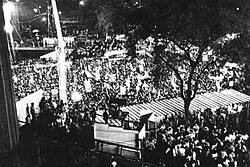 |
| Anhagabau, 1984. During the Diretos Já Protests. |

i liked it! i didnt know diretas já happened there, thought twas in praça da sé... looking forward to reading more!
ReplyDeleteyou know, felipe, i thought direitos já was in praça da sé as well. could it be that there was more than one action? i mean, it was an extended movement.
ReplyDeleteI could also be terribly wrong.